Introduction
The EU AI Act (Regulation (EU) 2024/1689) stands as the world's first comprehensive legal framework for Artificial Intelligence. Designed to foster innovation while ensuring the safety and trustworthiness of AI systems, the Act standardizes rules for the development, marketing, and usage of AI across the European Union.
Unlike voluntary guidelines, this regulation is legally binding and carries significant penalties for non-compliance. For enterprise leaders, understanding its scope and mechanisms is no longer optional it is a critical imperative for sustainable digital strategy.
Target and Objectives
The primary goal of the AI Act is to create a "human-centric" approach to AI, balancing technological advancement with the protection of fundamental rights, democracy, and environmental sustainability. It establishes a uniform legal framework to prevent market fragmentation within the EU single market.
The regulation applies to a broad range of stakeholders:
- Providers: Entities that develop AI systems or general-purpose AI models and place them on the market.
- Deployers: Organizations using AI systems under their authority (e.g., for hiring or credit scoring).
- Importers and Distributors: Intermediaries making AI systems available in the EU.
Key Content: A Risk-Based Approach
At the core of the EU AI Act is a risk-based classification system that determines the level of regulatory scrutiny an AI system faces:
1. Unacceptable Risk (Prohibited)
Some AI practices are deemed deemed so harmful that they are outright banned. These include social scoring by governments, real-time remote biometric identification in public spaces by law enforcement (with narrow exceptions), and AI systems that use subliminal techniques to manipulate behavior.
2. High Risk (Regulated)
This is the most critical category for enterprises. High-risk systems include those used in critical infrastructure, education, employment (e.g., CV-scanning tools), credit scoring, and law enforcement. Providers of such systems must:
- Establish a rigorous risk management system.
- Ensure high-quality data governance to prevent bias.
- Maintain detailed technical documentation and record-keeping (logging).
- Guarantee transparency and provide clear information to users.
- Implement human oversight measures.
- Undergo a conformity assessment to affix the CE marking.
3. Limited Risk (Transparency)
Systems with specific transparency risks, such as chatbots and deepfakes, have lighter obligations. The primary requirement is disclosure: users must be informed they are interacting with an AI (e.g., "I am a chatbot") or that content has been artificially generated or manipulated.
4. Minimal Risk
The vast majority of AI systems (e.g., spam filters, video games) fall here and are largely unregulated, though voluntary codes of conduct are encouraged.
General-Purpose AI (GPAI)
The Act introduces specific rules for GPAI models (like large language models). "Systemic" GPAI models those with cumulative compute power above 10^25 FLOPs face stricter rules, including model evaluations, adversarial testing ("red teaming"), and incident reporting.
Impact on Non-EU Companies
The EU AI Act has significant extraterritorial reach. It applies to any organization, regardless of its location, if:
- They place AI systems on the EU market.
- They put AI systems into service in the EU.
- The output produced by their AI system is used within the EU.
This means a US or Asian tech company offering an AI service accessible to EU citizens, or whose results are utilized by an EU subsidiary, falls under the Act's jurisdiction. Non-compliance can lead to fines of up to €35 million or 7% of global annual turnover, whichever is higher.
Timeline for Compliance
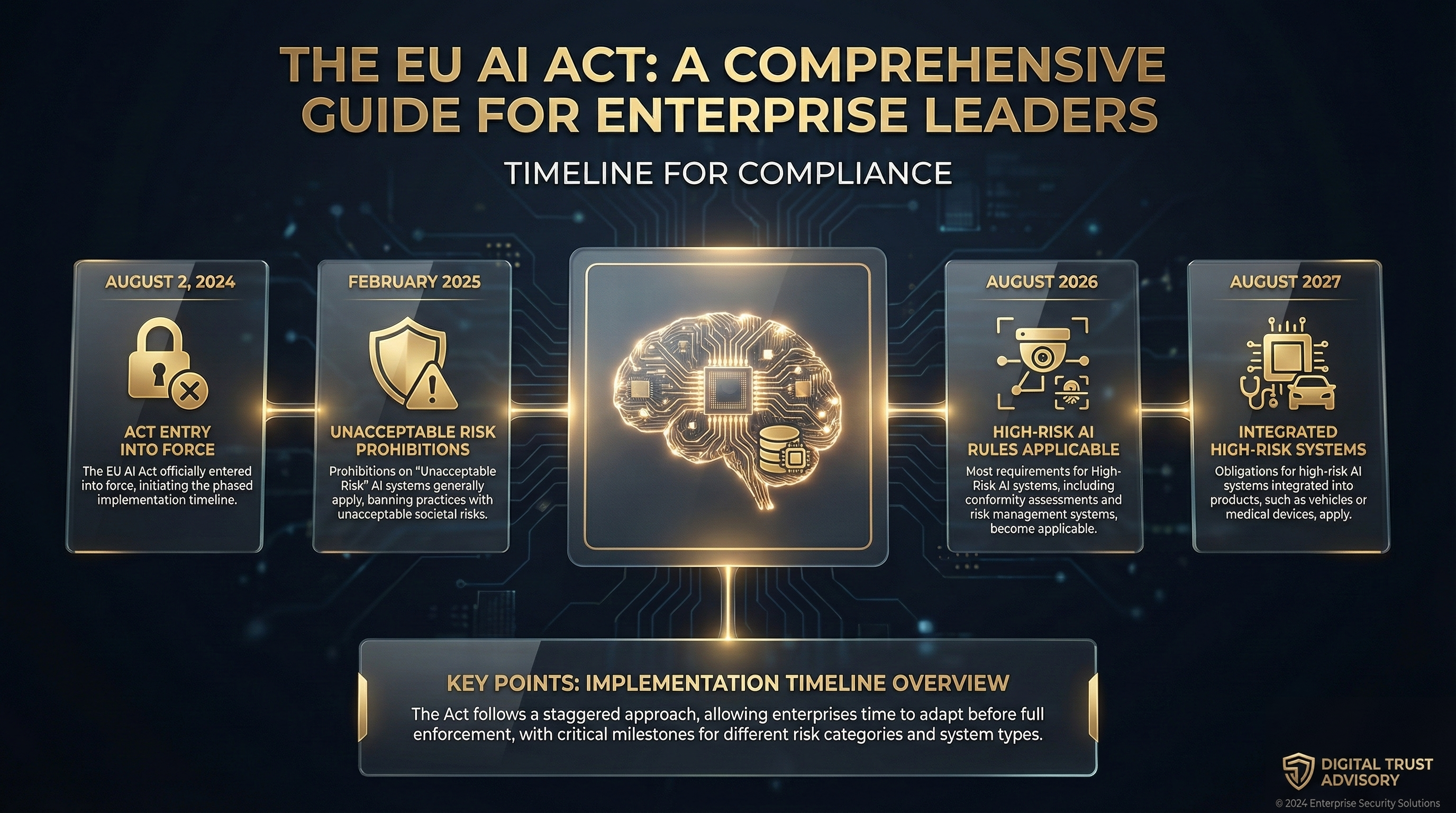
The Act entered into force on August 2, 2024, with a staggered implementation timeline:
- February 2025: Prohibitions on "Unacceptable Risk" AI generally apply.
- August 2025: Rules for General-Purpose AI (GPAI) models come into effect.
- August 2026: Most rules for High-Risk AI systems become applicable.
- August 2027: Obligations for high-risk systems integrated into products (like cars or medical devices) apply.
"The EU AI Act is not just a regulatory hurdle; it is a blueprint for the future of responsible AI. Early preparation will be a competitive advantage."
