The Dawn of Standardized AI Governance
In December 2023, the release of ISO/IEC 42001 marked a watershed moment for the Artificial Intelligence industry. As the world's first international standard for Artificial Intelligence Management Systems (AIMS), it moves the conversation from abstract ethical principles to concrete, auditable operational requirements.
For enterprise leaders, ISO 42001 is more than a badge of honor; it is a strategic mechanism to navigate the complex web of global regulations—including the EU AI Act—while building ensuring trust with stakeholders.
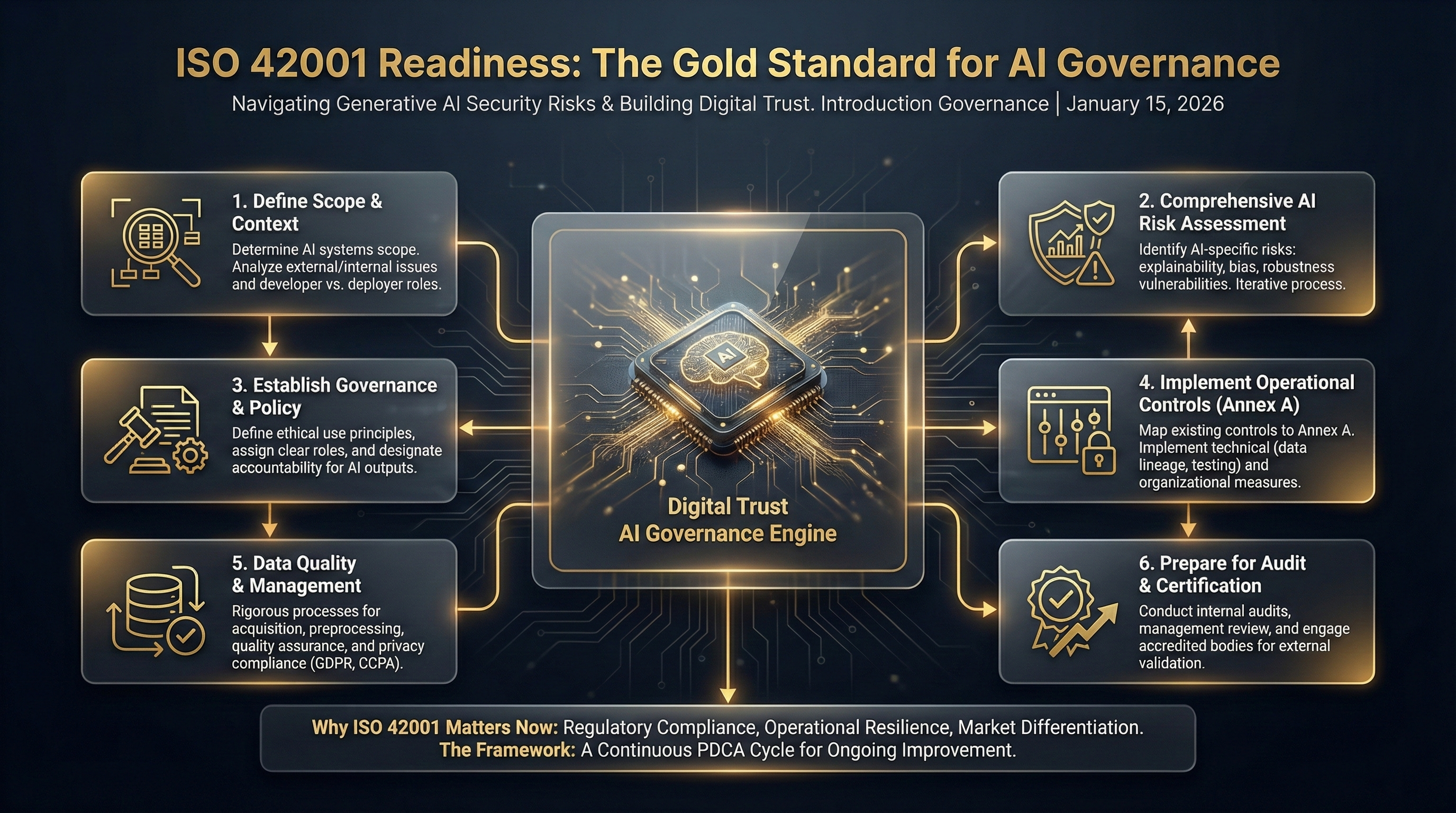
Why ISO 42001 Matters Now
The "move fast and break things" era of AI is over. Organizations are now accountable for the systems they deploy. ISO 42001 provides a structured way to address:
- Regulatory Compliance: It aligns closely with the risk-based approaches of major regulations like the EU AI Act and the NIST AI RMF.
- Operational Resilience: It forces organizations to systematically identify and mitigate AI-specific risks, from data poisoning to model drift.
- Market Differentiation: Certification serves as a powerful signal of maturity and trustworthiness to clients and partners.
The Framework: A Continuous Cycle
Like its predecessors (ISO 27001 for security, ISO 9001 for quality), ISO 42001 is built on the Plan-Do-Check-Act (PDCA) cycle. This ensures that AI governance is not a one-time project but an ongoing process of improvement and adaptation to new technologies and threats.
6 Steps to Readiness
Achieving compliance requires a cross-functional effort involving IT, legal, security, and business units. Here is a practical roadmap to get started:
1. Define Scope and Context
Not every algorithm needs the same level of oversight. Determine which AI systems fall within the scope of your AIMS. Consider the context: Are you a developer of AI models or a deployer of third-party tools? What are the external and internal issues relevant to your AI strategy?
2. Conduct a Comprehensive AI Risk Assessment
This is the heart of the standard. You must identify risks specific to AI, such as lack of explainability, bias, and robustness vulnerabilities. The assessment must be iterative, updating as models evolve or new data is introduced.
3. Establish Governance and Policy
Define the "rules of the road." This includes creating an AI Policy that outlines principles for ethical use. Crucially, assign clear roles and responsibilities—designating who is accountable for AI outputs is often the biggest hurdle for large enterprises.
4. Implement Operational Controls (Annex A)
ISO 42001’s Annex A lists controls to mitigate identified risks. These range from technical measures (like data lineage tracking and model testing) to organizational controls (like staff training and impact assessments). Map your existing controls to these requirements to identify gaps.
5. Data Quality and Management
AI is only as good as the data it feeds on. Implement rigorous processes for data acquisition, preprocessing, and quality assurance. Ensure you have the rights to use the data and that privacy obligations (GDPR, CCPA) are met.
6. Prepare for Audit and Certification
Once your AIMS is operational, conduct internal audits to verify compliance. Management review is essential to ensure the system is meeting its objectives. Finally, engage an accredited certification body for the external audit to validate your readiness.
Conclusion
ISO 42001 represents the maturity of the AI ecosystem. By adopting this standard, organizations can shift from reactive compliance to proactive governance, turning responsible AI from a constraint into a competitive engine.